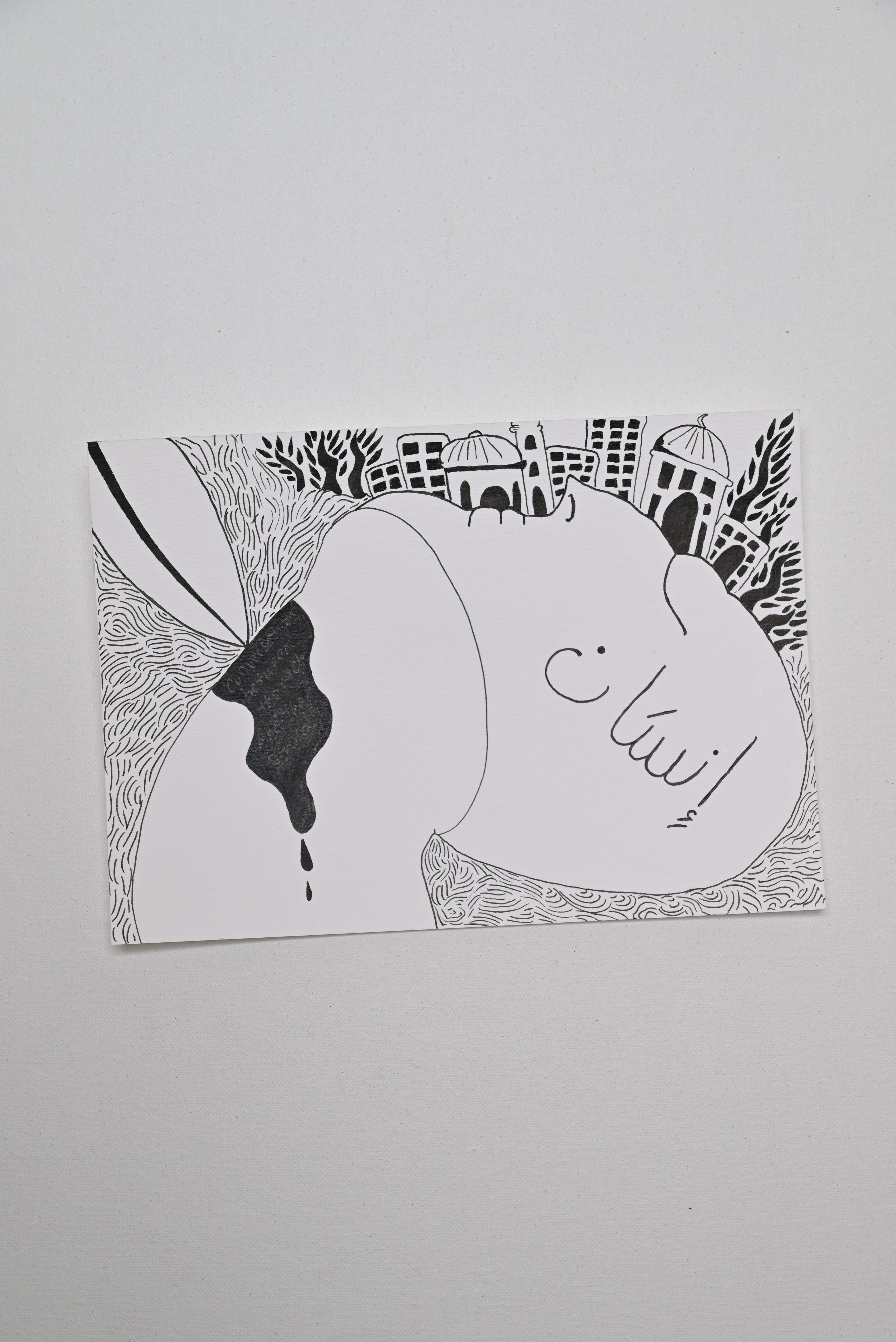
Conversations Between the Sword and the Neck
Unity, human histories, and free will
If you open the closet of human history, an avalanche of skeletal heads will rattle and roll to the floor. No bodies, just skulls—the remnants of minds who chose death over willing surrender to human forms of power. Cut down by the sword, they passed from record, becoming unobservable on the land. But then empires fell, fortresses were abandoned, and they returned. The land gives rise to various histories, documenting their duration by the ink of the sun.
Recently, at the end of a panel discussion on representation of Arab and Muslim women in the media, it was suggested by an audience member that we cease from pointing the finger at empire and take spiritual responsibility by recognizing the oneness of humanity in spirit. Lead with love, the speaker said. Every generation comes from the wombs of women. The men will follow. She praised the lone white male in the room for enduring our criticisms. Unity, she insisted. We need unity. Be more like Phil, whose willingness to listen, she explained, was superior to the willingness of panelists to share their vulnerabilities whilst being the subjects of live-streamed genocide and epistemological decapitation.
Unexplainably, there was a strong round of applause, followed by a group photo, in which the audience member, who had usurped the role of moderator from the youth organizers, begged everyone say, “Unity!” for the betterment of our smiles. Quietly, unnoticeably, our powerful statements on Palestinian solidarity vanished from the room to be replaced thereafter with several platters of Palestinian food. The oneness of humanity in the belly of Empire unsurprisingly carried the stench of ritualistic cannibalism.
By the time I got home, my mind was greatly unsettled. A familiar pulsing headache brought on by a spike in blood pressure stayed with me all evening and the next day, my thoughts wrestling one another. In an abstract sense, the benefits of unity to humanity are unarguable, but in the material realm—where falsehood leads to corruption, corruption to oppression, and oppression to violence—the harms are also undeniable. Hence, the necessity of free will. We have the capacity to choose community, based on understandings of truth and justice. If humanity were to overcome its divisions and become a single entity, the surrender of free will would be the subordinate clause of the contract, written in fine print.
Having arrived at these conclusions, I still felt uneasy. What about my faith, Islam? Does the Quran truly demand human uniformity as people often claim? The following ayat came to my attention as I sought understanding of the Quran’s message on free will and human histories. A reader can apply their own reasoning. I am not a trained religious scholar.
“We have revealed to you this Book with the truth, as a confirmation of previous Scriptures and a supreme authority on them. So judge between them by what God has revealed and do not follow their desires over the truth that has come to you. To each of you we have ordained a code of law and a way of life. If God had willed, He would have made you one community, but His Will is to test you with what he has given you. So compete with one another in doing good. To God you will all return, then He will inform you regarding your differences.” (6:48)
“If you were to obey most of those on earth, they would lead you away from God’s Way. They follow nothing but assumptions and do nothing but lie.” (6:116)
“Your Lord is Self-Sufficient, Full of Mercy. If He wills, He can do away with you and replace you with whoever He wills, just as He produced you from the offspring of other people.” (6:133)
“As for the disbelievers, they are guardians of one another. Unless you [believers] act likewise, there will be great oppression and corruption in the land.” (8:73)
“Humanity was once nothing but a single community, but then they differed. Had it not been for a prior decree from your Lord, their differences would have been settled.// They ask, ‘Why has no sign been sent down to him from his Lord?’ Say, ‘The knowledge of the unseen is with God alone. So wait! I too am waiting with you.” (10:19-20)
“Had your Lord so willed all on earth would have certainly believed, every single one of them! Would you then force people to become believers? It is not for any soul to believe except by God’s leave, and He will bring His wrath upon those who are unmindful.” (10:116)
“Indeed, We had given Moses the Scripture, but differences arose regarding it. Had it not been for a prior decree from your Lord, their differences would have been settled. They are truly in alarming doubt about it.” (11:110)
“If only there had been among the [destroyed] peoples before you, virtuous individuals who forbade corruption in the land—other than the few We had saved. But the wrongdoers pursued their pleasures, becoming wicked.” (11:116)
“Had your Lord so willed, He would have certainly made humanity one single community, but they will always differ—” (11:118)
“To God belongs the knowledge of what is hidden in the heavens and the earth. And to Him all matters are returned. So worship Him and put your trust in Him. And your Lord is never unaware of what you do.” (11:123)
“It is upon God to show the Straight Way. Other ways are deviant. Had He willed, He would have easily guided you all.” (16:9)
“Do not follow what you have no knowledge of. Indeed, all will be called to account for [their] hearing, sight, and intellect.” (17:36)
Translations by Dr. Mustafa Khattab, The Clear Quran. (Note that The Clear Quran does not include the Arabic original alongside the translation and is therefore a study guide.)
My headache has returned with the writing of this post. My heart aches. I wrestle with recent statements made by people in my life, who feel sympathetic enough to mention Palestinian suffering. It used to be a forbidden topic in most realms of my life, so I am grateful for this small measure of inclusion, yet their hospitality is offset with criticisms. Palestinians should do a,b,c and x, y, z. They never mention what they themselves should do to defend their beliefs and histories from tyranny and oppression, as though Palestinians were the only community in the world to have been given the burden of free will and the rest of us were merely commentators or nonparticipant players in the game of life.